The pool dashboard shows both mining work and the blocks that work finds. This guide explains how to read effort percentages, expected block times and round history on bntpool.com. You will be able to distinguish a statistical average from a countdown, then check your own mining connection without waiting for the pool's next block.
What is mining pool luck?
Mining pool luck describes how actual block discovery compares with the average expected from the pool's work. Blocks arrive at random: some take little work and others take more. On bntpool.com, round effort compares accepted share work with block difficulty; a lower effort means the round found its block with less recorded work.
A pool combines many miners' attempts, but it still has to find a hash that meets the network target. Accepted shares measure contributions at an easier target. They help the pool estimate how much hashing happened between discoveries. The mining-pool introduction explains that relationship; luck describes the variation in the resulting blocks.
How does the pool calculate effort?
For a completed round, bntpool.com divides accepted share work by the block's difficulty and multiplies by 100. Share work is difficulty-weighted, so it is not just the number of submitted shares. A share at a higher assigned difficulty represents more expected hashing work than one at a lower difficulty.
Effort (%) = accepted share work ÷ block difficulty × 100
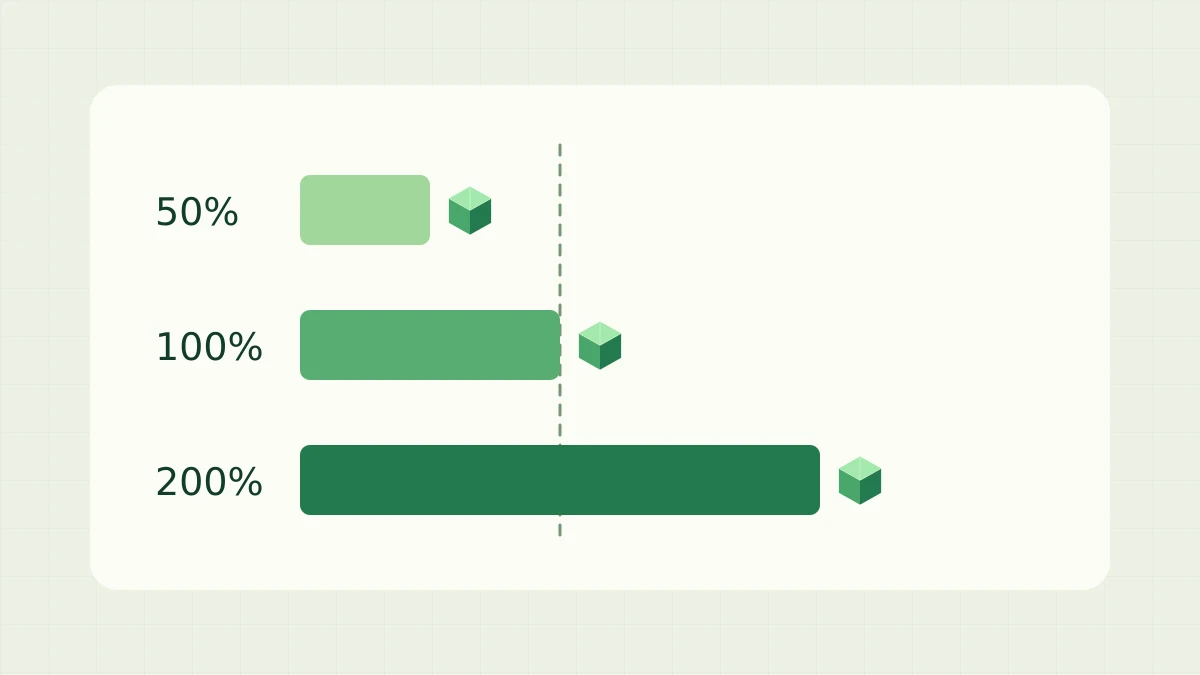
For example, suppose a block has difficulty 10,000 and the pool records 5,000 units of accepted work during its round. Its effort is 50%. With 20,000 units of work at the same block difficulty, it would be 200%. These are arithmetic examples, not measurements of a particular production block.
| Effort | How to read it |
|---|---|
| 50% | Half the expected work for that difficulty |
| 100% | The expected amount of work for one block |
| 200% | Twice the expected work for that difficulty |
Current-round effort uses the current difficulty, which can change as the chain advances. Historical rows use their block difficulty. The figure is therefore a work comparison, not a progress meter that must stop at 100%. It is also distinct from round duration: a faster pool can perform the same amount of work in less time.
What does expected block time mean?
Expected block time is the average interval suggested by the pool's estimated share of network hashrate. The bntpool.com dashboard calculates it as 300 seconds multiplied by network hashrate divided by pool hashrate. Use both rates in the same units. The hashrate guide explains why these estimates change as accepted shares and new blocks arrive.
Expected seconds = 300 × network H/s ÷ pool H/s
If the network is estimated at 100,000 H/s and the pool at 10,000 H/s, the pool has one tenth of the estimated total. Its expected interval is 3,000 seconds, or 50 minutes. That average can describe a mixture of short and long rounds; it does not schedule the next block for exactly 50 minutes from now.
The dashboard also compares elapsed time with expected time. This time-based percentage and share-based effort can differ because they use different inputs. Compare the label before comparing two numbers. Changes in pool hashrate or network difficulty can move the current estimate even while the same round is still running.
Is a block due after 100% effort?
A pool is not due a block when effort reaches 100%. Previous unsuccessful hashes do not make the next hash more likely to pass an unchanged network target. With constant hashrate and difficulty, the expected wait from now remains the same, even after a long round. More mining work creates more attempts, not a deadline.
A simple probability model makes this easier to see. With independent attempts and a constant block-finding rate, waiting time is approximately exponential. The chance of no block after one expected interval is about 36.8%; after two it is about 13.5%; after three it is about 5.0%. Those percentages describe many hypothetical rounds under fixed conditions, not a forecast for the current pool round.
| Elapsed expected intervals | Approximate chance of no block yet |
|---|---|
| 1 × | 36.8% |
| 2 × | 13.5% |
| 3 × | 5.0% |
The calculation is exp(-t / T), where T is the mean interval and t is elapsed time. The NIST exponential-distribution reference gives this survival function. Real hashrate and difficulty vary, so treat the table as an explanation of randomness. A streak of quick blocks also leaves the next hash's probability unchanged when the target stays the same.
How do you read bntpool.com's luck history?
Open Luck to compare completed rounds. Each row shows a block, effort, round time, status and discovery time. Look at several rounds together rather than choosing one unusually short or long row. The block link lets you inspect the corresponding chain record, while pagination lets you examine a wider history.
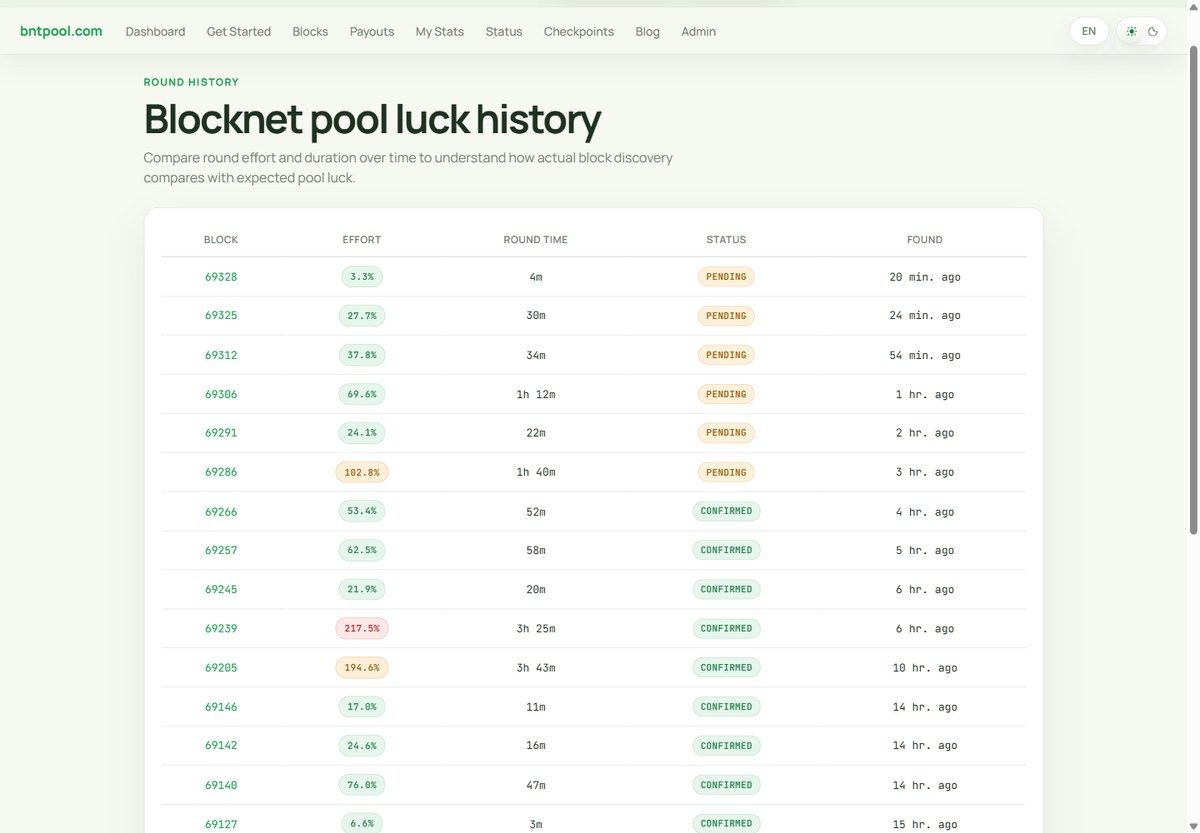
This screenshot was captured on October 26, 2026. Its rows and statuses are a historical snapshot; use the live page for current values. A pending or confirmed status describes the block's confirmation state. It does not change what the recorded effort percentage means, and it is separate from a payment to your address.
On the dashboard, Average Luck is the arithmetic mean of recorded effort percentages for non-orphaned blocks up to the current chain height. Despite the card's name, it follows the effort convention: lower means less recorded work per block. Averages summarize that sample. They do not promise that future rounds will compensate for any particular earlier result.
How does pool luck affect your rewards?
Pool luck changes when blocks are found. PPLNS decides how a found block's reward is allocated among eligible accepted work. Those are different steps. A round boundary does not turn the PPLNS window into a round-only payout rule; read how PPLNS payouts work for the actual window, confirmations and payment threshold.
Your balance can therefore move in steps even while your miner keeps submitting accepted shares. The rewards calculator estimates output from hashrate and network inputs. It is useful for expectations over time; it does not predict the block or the moment when a payment will reach your wallet.
What should you check during a long round?
Check the parts you can observe directly: your miner is running, accepted shares continue, and the correct address appears on My Stats. Use Status for public service health. If your own accepted shares stop, follow the miner-statistics troubleshooting guide; a long pool round and a disconnected rig need different checks.
Once your connection is healthy, read luck across a meaningful history and keep using the same definitions. That gives each dashboard number a clear role: hashrate estimates work per second, effort compares work with a block's expected work, and your balances show reward accounting. None of those requires guessing when the next winning hash will arrive.
Frequently asked questions
Does 100% effort mean the pool is about to find a block?
No. It means the pool's recorded share work has reached the amount expected for one block at the difficulty used in that calculation. It is a comparison with an average, not a completion percentage. Each new hash still needs to satisfy the network target.
Is a lower pool luck percentage better on bntpool.com?
Read the label and definition first. The bntpool.com Effort column and Average Luck card express work relative to expected work, so lower values mean less recorded work per block. Other sites may use the inverse convention. Compare matching metrics and sample sizes rather than percentages alone.
Will a long round increase my next payout?
A long round does not guarantee a larger personal payout. Block discovery decides when a reward becomes available, while the pool's PPLNS accounting decides your share using eligible accepted work. Confirmation and payout rules apply afterward. Check My Stats for your own balances and the payout guide for the sequence.